Home Lab
Overview
A five-node, segmented home infrastructure environment designed to mirror many of the architectural patterns used in enterprise technology environments.
Design Goals
Build a small infrastructure environment around enterprise principles.
Security & Segmentation
Separate trust zones and allow only the communication that is required.
Reliability
Reduce single points of failure and design services around predictable operations.
Local Control & Privacy
Keep core services and personal data under local control where practical.
Automation
Replace repetitive manual work with repeatable, observable workflows.
Recoverability
Design systems so configuration and data can be restored rather than merely kept running.
Continuous Learning
Use the lab to develop practical skills in infrastructure, DevOps, observability, security, and AI.
Architecture+
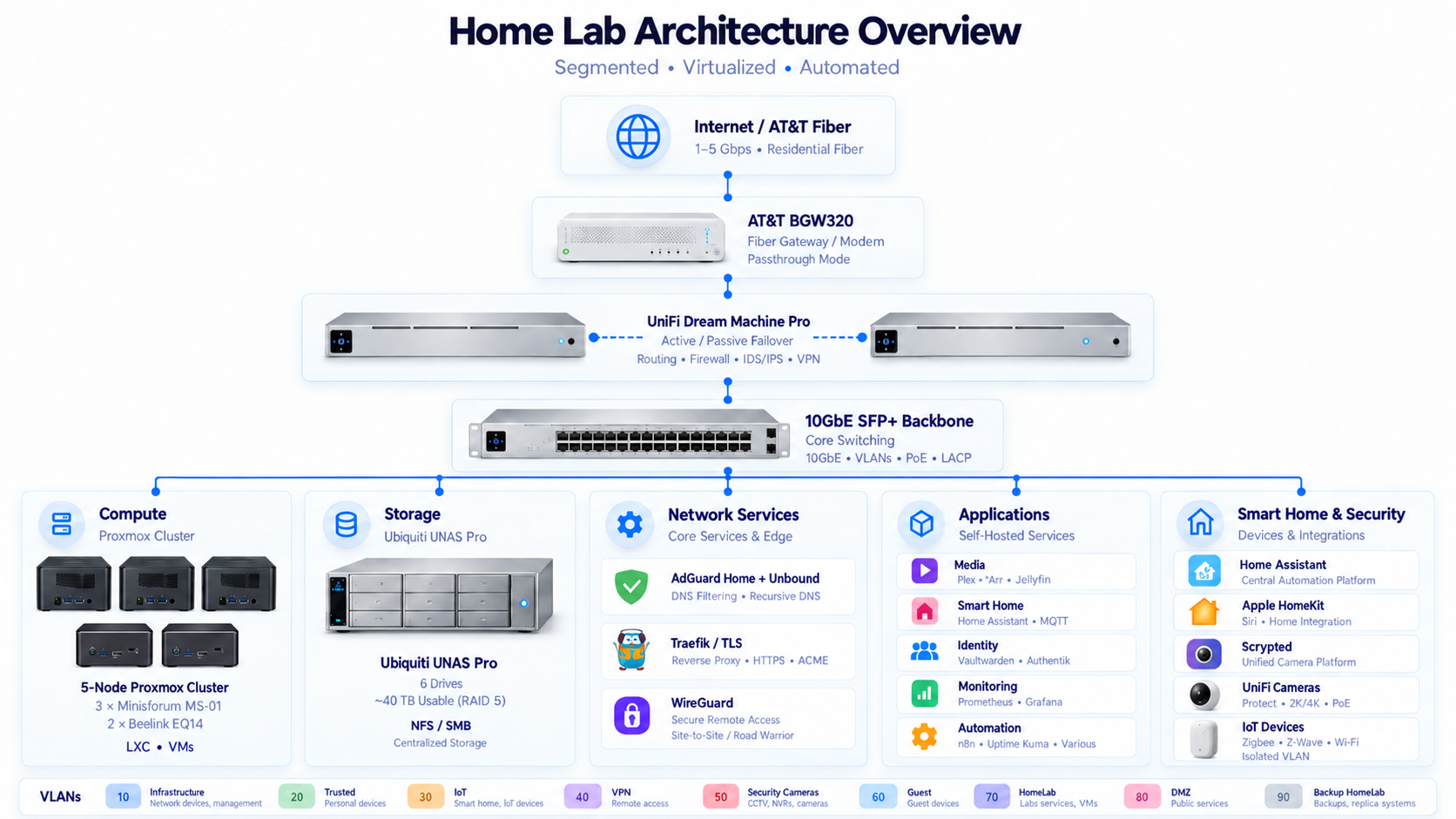
The lab is built around a five-node Proxmox cluster consisting of three Minisforum MS-01 systems and two Beelink EQ14 nodes.
Compute, networking, storage, security, automation, and application services are intentionally separated into logical layers rather than operating as a collection of standalone devices.
The environment is designed to provide a platform for virtualization, containerized workloads, infrastructure experimentation, DevOps, automation, security testing, and AI-driven operations.
Physical Infrastructure+
The home lab is centralized in a 24U floor rack located in an upstairs guest-bedroom closet.
The builder originally provided only a small in-wall structured wiring cabinet, which was not large enough for the infrastructure the environment eventually required.
To create a proper central distribution point, new fiber was run to the guest-bedroom closet and the space was converted into the primary home-lab and Ethernet aggregation location.
Cat6A cabling was personally installed, terminated, crimped, and distributed throughout the house to provide dedicated wired connectivity to rooms, access points, cameras, switches, and infrastructure devices.
SFP+ connectivity is used between core networking components to provide a faster backbone for east-west traffic between switching, compute, storage, and other infrastructure services.
The rack contains the core network, compute, and storage platforms, including the UniFi gateway and switching environment, three Minisforum MS-01 systems, two Beelink EQ14 systems, and the Ubiquiti UNAS Pro.
The UniFi switching environment includes a USW 16 PoE, USW Aggregation, USW Pro Max 24 PoE, and smaller access switches serving areas such as the family room and office.
Wireless coverage is provided through multiple UniFi access points, including two U6-LR units and two U6 Lite-class access points distributed through the house.
The current camera environment includes six UniFi cameras: four PoE cameras and two wireless cameras. The roadmap includes adding two additional wired cameras and two additional wireless cameras.
Centralizing the infrastructure in a dedicated rack created a much cleaner physical topology than attempting to expand the original builder-installed cabinet and provides room for future network, storage, compute, and power improvements.
Network Design+
The network is built around a redundant pair of UniFi Dream Machine Pro gateways configured in an active/passive failover model.
A managed UniFi switching environment and a 10GbE SFP+ backbone provide connectivity between core infrastructure, compute nodes, storage, wireless access points, cameras, IoT devices, and trusted endpoints.
Multiple VLANs segment infrastructure, trusted devices, IoT systems, VPN traffic, security cameras, guest devices, homelab workloads, DMZ services, and backup infrastructure.
Inter-VLAN communication is controlled through firewall policy rather than being implicitly allowed.
Compute Platform+
Virtualization is provided by a five-host Proxmox environment.
Three Minisforum MS-01 systems provide the primary compute capacity, while two Beelink EQ14 nodes provide additional lightweight compute resources.
Virtual machines and containers host core network services, identity platforms, media applications, automation systems, databases, monitoring platforms, and development workloads.
Storage+
Centralized storage is provided by a Ubiquiti UNAS Pro populated with six drives providing approximately 40 TB of usable capacity after RAID 5.
The storage platform supports shared application data, media, backups, virtual machine workloads, snapshots, and other infrastructure services.
NFS and SMB provide network-based access while allowing storage to remain independent from individual compute nodes.
Core Services+
The environment hosts a broad collection of self-hosted services including Authentik, Vaultwarden, AdGuard, Unbound, Traefik, WireGuard, Home Assistant, Zigbee2MQTT, Mosquitto, Plex, Jellyfin, Sonarr, Radarr, Redis, PostgreSQL, Portainer, and other supporting platforms.
These services provide identity, networking, automation, media, data, remote access, security, and application capabilities.
Security & Segmentation+
Security is built into the architecture through VLAN segmentation, firewall policy, IDS/IPS capabilities, DNS filtering, isolated IoT and camera networks, controlled remote access, and separate DMZ and backup network segments.
The goal is to treat the environment as a small enterprise network rather than a single trusted home LAN.
Automation & AI+
The lab also serves as a development environment for automation and AI.
Current and planned work includes GitHub-based CI/CD, n8n workflows, infrastructure automation, AI agents, network monitoring, automated documentation, and eventually controlled AI-assisted infrastructure operations.